Showing posts with label Homemaking. Show all posts

17 Jul 2017

Companion Planting

I have been learning about companion planting.  Companion planting is planting compatible plants next to or in close proximity to each other.  These plants help each other.  They help with the plant’s general health, as well as act as deterrents for pests and diseases.  And they really do work!  Here is a list of some of the fruit trees in my garden with their corresponding companion plants.  I have seen the ‘fruits of their labours’!  I have watched as the fruit tree itself picks up.  I noticed this especially with my plum and apricot trees.  I *think* it’s because of the tansy…..

PLUM - tansy chives, marigolds dahlia

QUINCE - garlic

PEARS/APPLES - chives, garlic, onions, nasturtiums, wallflower, marigolds

ALMOND - tansy, garlic, chives, marigolds, dahlia, nasturtiums

APRICOT - southernwood, tansy, basil

CHERRY - potatoes (no plums)

LEMON - lavender, chives, garlic, onions, horseradish 

CURRANTS - marigolds, dahlia

PEACH - tansy, garlic, basil, chives, marigolds, lemon balm, spinach, nasturtiums, dahlia

The fruit trees are now mature and I do believe they had a good start in life.  Good healthy soil will always nourish the plant itself.

One of my brothers swears by planting according to the moon's phases, but I haven't tried that as yet.  Seeing as the companion planting method worked so well, it encourages me to try a variety of other methods.


15 Jul 2017

In My Home - 9 to 15 July 2017

IN MY HOME RECENTLY 9 TO 15 JULY 2017

Like many people this time of the year, I've had a cold with aches and pains, so not much has been done on the homemaking / housekeeping front.  Guilt is always a major factor when I'm not up and about and - well - just merely 'present' for and with my family.  The Machinist always takes good care of me and despite being busy himself, he settles me on the couch, tucks me in and puts my phone nearby - "Helen, call me if you need anything.  I'm only a phone call away.  Now please, Babe - just ring". He dosed me up on grape seed extract, Doterra *tm throat lozenges and water.  He also arranged with Emma to pick up something "treat-like" from town. It is for these reasons, I'm not sick for long.  "I'm so glad you're feeling well again, Babe", he says.  "I hate it when you're sick.  Things just aren't the same..."

My brother, being a chef of many years, but now retired has been sharing his personal favourite dishes with me.  He loves stews and soups and a variety of wet dishes in winter.  I've been trying each of them out and freezing (in IKEA glass containers) any leftovers.  This has given me the inspiration to change, add to and modify for our own personal tastes.

In one of his recipes, he uses ground beef with ground pork.  I had used all my ground beef, so I made this with the ground pork:

Saute 500g bacon.  Set aside
Brown 2 onions.  Set aside.
Brown 500g ground pork.  Set aside.
(at this stage, the pan has some really tasty flavours).
Add 2t chopped chilli and sauté for a minute
Return everything to pan
Add 2 cans tomatoes (I use the organic canned cherry tomatoes from Aldi)
Add 2 cups or 3 zucchini (spiralled or grated)
Add 1t paprika
Stir.
Cook on high until bubbling, then turn on low and simmer.
I served this over cauliflower 'rice'.


If you want to add "body" or "creaminess" to a dish, add a heaped tablespoon of hummus and stir it in to soups, stews or casseroles.  It is better to add it to the individual serve.  I buy a small bucket of hummus from Costco for around $6.


I've been learning about the benefits of Epsom salts added to bath water.  Epsom salts, when purchased at most grocery stores, costs around $4 - 6 per kg box.  I found an online company - The Salt Box -  that offers free shipping, if the salts are bought in bulk.  I bought two 25kg bags of Natural Epsom Salts (50kg!) for $118 or $2.36 per kg.   (I know this is a lot of Epsom salts, but I will share it with my family). I fill a Mason jar, then add about 5 drops of Citrus Bliss oil by Doterra and shake (distribute) well.

*Noteworthy: - previously, I had been adding essential oils to the bathwater, as the taps were running.  While bathing, I sensed my skin tingling, then slightly burning.  Sarah told me that it was because the oil had formed a 'film' on the surface of the water, and I broken that surface, getting into the bath - hence the oil dispersed directly on my skin.  It is better to use some type of carrier oil with the essential oil.  Or - salts.


Whenever I can - usually during our Christmas break (or when I'm sick and taking 'down' time), I work on a genealogy project.  Case at hand - my father's family.  He will be 92 this year and although I've given him snippets of his father's life  over the years (by researching the census archives), I'm putting together his paternal and maternal ancestry and hope to present it to him as a 'Full Package' on his birthday.  Last week, I took a few days 'sickie', as the Aussies say, and was able to work on this project.  As a result of the time taken on genealogy research,  I also sent off my own Ancestry DNA*tm  (which was a gift from Cam and Sarah to me last Christmas!).  I hope you're reading this, Acorn.  It's gone! 


Something I've trained myself in, from many years of housekeeping in a large, long, one story house, is to save my legs.  Particularly so when feeling tired, achy or out of sorts.  If I have to drop something off in our bedroom, for instance, I 'scan' the room for anything that has to be taken to another room.  It is sort of a challenge for me now - not to go empty handed from one end of the house to the other.


With taking things slower - many things come to mind and I begin to realise a lot about myself.  One of them being that I am an over-achiever.  I don't mean to sound proud by saying this, as really, it can be most burdensome and a stress on those I love.  I always expect 'more' from me.  They don't, but I do.  This can lead to disappointment (me, myself, I) - something a patient doesn't need when they aren't feeling well.  Taking steps to counteract this natural urge to expect more, I've made lists, changed schedules, written things down once so as not to have to 'think' again.   I actually LOVE doing this, as it 'feels' like I'm moving forward (even when I'm not moving!).  I find that this time of re-assessment, if you will - actually helps towards recovery.  It inspires me.  Furthermore, I recognise that it's not something I would take the time to do in our busy, every day lives.  #winning

Enjoy your Homemaking!

14 Jul 2017

Raised Garden Beds

I find that on cold winter days, even though I love them and long for them the rest of the year, my mind drifts to when the garden will be productive and colourful again come spring and summer.  Winter is time to plan and prepare for the onslaught of prospective growth and all it entails.  

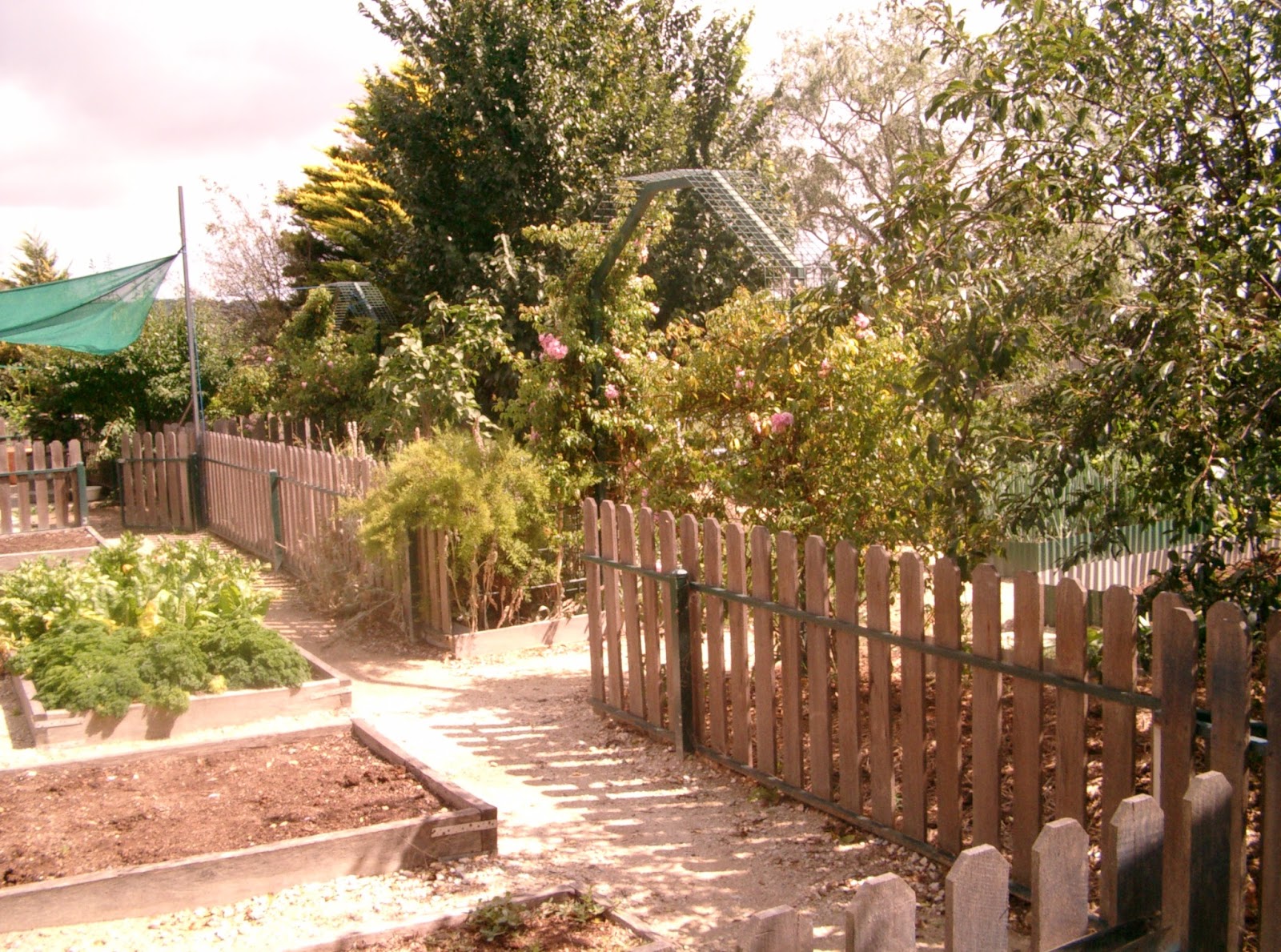
This is a summary of how one of our garden 'rooms' used to look.  Although you can't rush a garden, it seems to change so regularly.  

*We still have raised garden beds; - we've moved them to another 'room', and they are now made from metal (because we are metal fabricators and - well - why not?).  

*We still have picket fences surrounding the garden rooms, but our pit bull cross, - Cezar by name - has busted a few of the panes out as he does his 'mad-half-hour' run around the garden in joy and excitement.  Machinist compares him to a Mack truck.

*The Russian Giant Sunflowers were a sheer delight.  Oh, and they were - HUGE. 

Anyway, moving on....


Our garden soil is mainly clay. Pure unadulterated clay. There isn't much one can do with clay soil - especially if a vegetable garden is on the cards. Clay soil becomes water logged. Very quickly. A brief spring shower can cause the clay soil to become like a mud-wrestler's performance ring. For years we tried to correct the clay soil, by adding gypsum. The soil improved, but the wet areas still returned - year after year. Until we learned about raised vegetable beds.

It is necessary to ensure that the wood used for contained, raised garden beds is not what is termed 'treated' wood. Reason being, the chemicals used to treat the wood can and do seep out of the wood and contaminate the soil which the vegetables grow in. This ultimately affects the plants. We used hardwood planks, to erect the 'frames' for our raised vegetable beds. Hardwood lasts a long time, before splitting or rotting. Many people call the hardwood planks 'sleepers' - a name given to the planks supporting the railway tracks, but the ones we used were nothing like the authentic railway sleepers.


 Our planks measure 2 metre x 1 metre per frame. We used galvanised brackets and nails to secure the frame together. Galvanised material will not rust. No rust, no rotting wood.

When the frames were completed, we carried them to their allocated site; a semi-gravelled driveway that we no longer wished to use as such. The gravel was part pebble and part road base. Weeds had already started to grow through the gravel, so these were first cut down before we laid the frames. It really doesn't matter where you start your raised vegetable garden, as long as it receives full sun for at least eight hours of the day.


On one side of the (former) driveway are the septic tanks, water tank and house, on the other side is our back garden. To make the whole area uniform, we covered the in-ground septic tanks with a colourbond sheeting, and built a raised, framed vegetable bed around them, forming a 'U' shape. Four frames running north/south and two frames running east/west were laid in position, making a total of 7 beds in this full-sun area. We placed thick newspapers within the frames to cover the ground and prevent further weed growth. Then began the task of filling the beds with soil.


The soil we chose was part pig manure/ part top soil. Over the years, we have added a variety of manures to this original soil, including turkey manure, which is by far the best. Chicken manure does the job as well, but the manure has to be at least a week old before you use it, otherwise it will burn your plants. Due to our clay problem, we decided to buy the soil in for these beds, but if you have excess garden soil you can improve it by the addition of manures and other organic matter. Once the beds were filled, we let them rest for 10 days before we planted our seedlings.

Between the frames, to prevent weed growth, we placed thick layers of hardwood sawdust - making paths. This wears down over time, but we continue to top it up when necessary. The amazing thing about sawdust is that very few snails like to pass over it. Whenever we see stumps where the lettuce was once thriving, we know it is time to top up the sawdust!

I turn around and the greens have gone to seed....
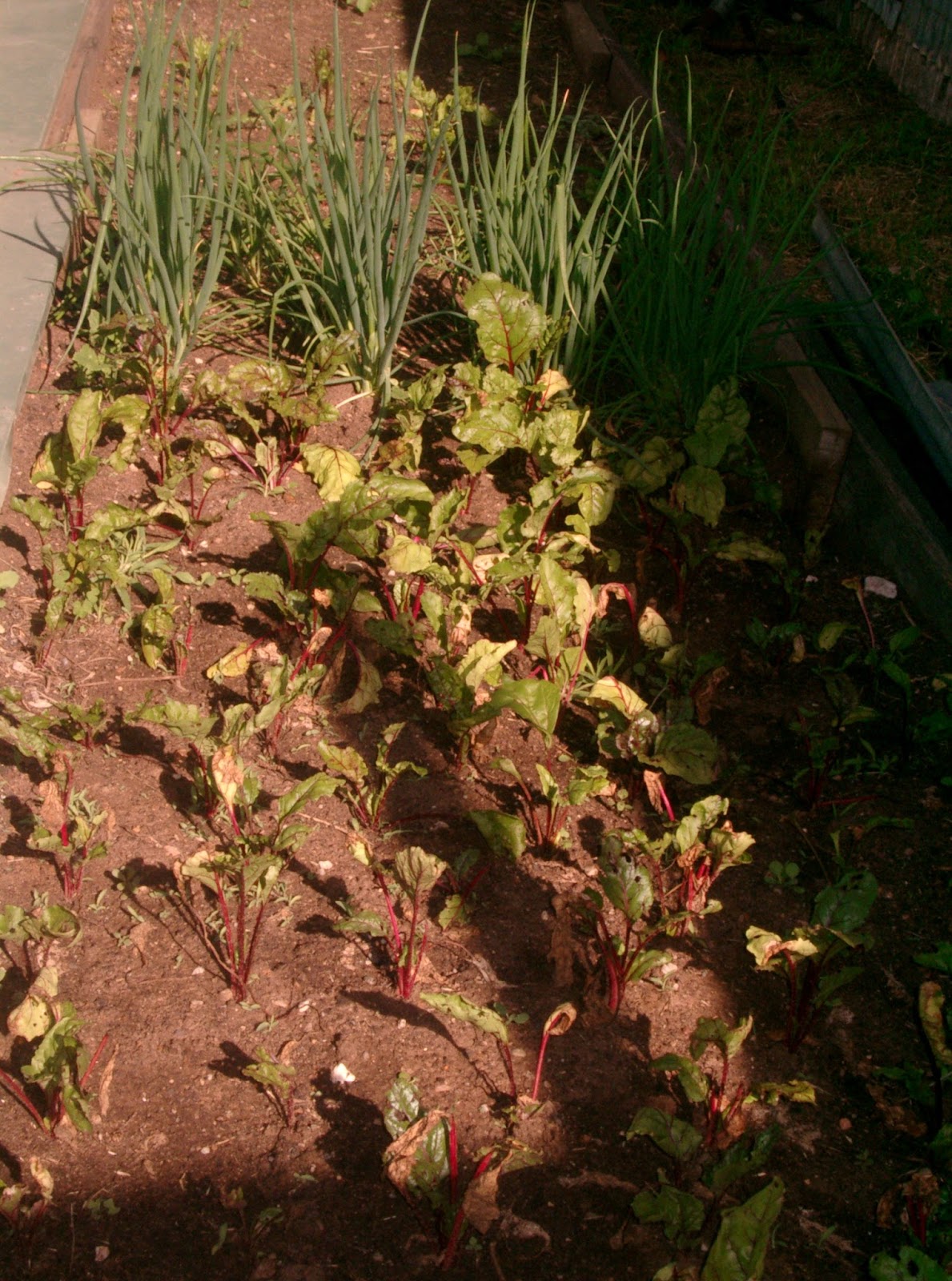
When planting in the vegetable beds, we use the companion planting method. Tomatoes are planted with basil. Nasturtiums and marigolds are planted with most other spring/summer vegetables. Each year, we rotate the beds, which means that we grow different types of vegetables in different garden beds. 'Musical beds', so to speak. We have learned not to mulch the seedlings until they show signs of growth and sturdiness. We used pea-straw mulch around our seedlings last year, and they turned black and died. The damp straw, heated by the sun created a humidifying effect, resulting in perfect growing conditions for bacteria and mildew. This naturally spread to the tender seedlings and they became overwhelmed. The black colour was a sure sign of mildew growth. What we do now is weed manually and regularly, if necessary, until the seedlings become taller, and then place the mulch around them. Diligence in weeding (and later mulching), watering and good drainage (which the raised beds offer) in the early stages of seedling growth pays off in the long run.

Herb Garden
Today, we have a quaint picket fence around our raised vegetable beds. On the other side of the picket fence we have foxgloves, sage, catmint, rose arbors, lambs ears and chrysanthemums. Before spring is over, we hope to plant Russian Giant sunflowers. This all makes for the seduction of beneficial insects and critters to the garden. Butterflies, ladybirds and basking lizards are all welcome visitors!

10 Jul 2017

In My Home

Many years ago, I subscribed, by email to a lady called Laine.  She would write letters to women who had a heart for, or who were struggling with and wanted to learn how to keep a home.  Her letters came out weekly and they were  simply called  "Laine's Letters".

Madam Adelaide at her writing table in Versailles - 1776
by Louis-Lie PERIN_SALBREUX 1753 - 1817

Each week, many of us would look forward to receiving Laine's "In My Home Recently" letter.  It comprised of tips, hints, a little advice, wisdom and practical how-to on matters of homemaking, being a sweet wife and training children.  Laine never claimed to know it all, and was still learning so much about keeping a home and family herself.  She willingly and openly described her own struggles.

Laine's children grew and some left home.  She later adopted a baby from China, and for a while, we were updated with news and progress on the adoption.  As far as we know, Laine stopped writing her letters when their new baby was "in her home".

In the the tradition of Laine's Letters, we will be doing our own "In My Home" letters.

We hope you will enjoy and even become inspired, as we did all those years ago.

Pass it on .......